Showing posts with label highly recommended. Show all posts

Thursday, January 26, 2012

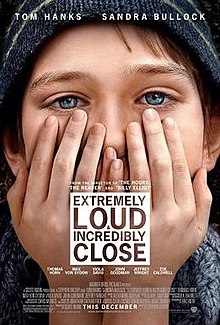
Extremely Loud & Incredibly Close (Stephen Daldry, 2011)

“Extremely Loud and Incredibly Close” is a deeply flawed film: over-sentimental, with a haphazardly changing tone, and an annoying voiceover. Yet, I cannot help but consider it one of the best films of the year. Led by the extraordinary young actor Thomas Horn, the film captures the misery of the 9/11 tragedy and crafts an incredibly sad, yet equally heartfelt and hopeful work. Based on Jonathan Safron Foer’s novel [previously reviewed], Stephen Daldry’s film tells the story of Oskar Schell, who sets out on a mission throughout New York to find the lock for a mysterious key his dead father—a victim of the September 11 attacks—left behind.

The film’s imperfections only further its impact. Like Oskar’s youthful grief, the film is often reckless, yet emotionally powerful. Daldry’s claustrophobic close-ups and visceral array of unusual angles perfectly frame the film, and bolster superb supporting performances by Sandra Bullock, Max Von Sydow, and Viola Davis. I do not expect everyone to like this film, and can definitely understand why people call it emotionally manipulative. However, I believe that films do not need to be perfect, but like every artform, should seek to transcend the cognitive and resonate emotionally in the audience. “Extremely Loud and Incredibly Close” made me cry.

Highly Recommended (A-)

Saturday, December 31, 2011

Everyman (Philip Roth, 2006)

“Everyman” opens with the funeral of an unnamed protagonist: a restrained event populated mostly by silence, which the reader experiences as an outsider. Philip Roth uses this starting point to barrage the reader with illnesses, failed marriages, and death, and tell the life of the deceased, unnamed man, focusing solely on his darkest moments. The novel draws inspiration from the 15th century morality play “The Summoning of Everyman,” in which God tallies a man’s good and evil deeds to determine his salvation. Roth similarly seeks to measure the worth of man, in accordance to his sins and moral failures. Despite the bleak stage Roth gives him, the reader is able to identify with the protagonist. This is “Everyman’s” greatest success: the universality of the human weaknesses it describes. We are the everyman.

Like most of Roth’s works, “Everyman” is constructed flawlessly, carefully releasing information about the protagonist’s life until the funeral’s silences acquire deep meaning. Roth’s prose flows very smoothly, and allows you to know the main character, but never to enter his mind. Like God’s judgment in the original passion play, Roth welcomes the reader to measure the value of the everyman’s life with no room for subjectivity. “Everyman” is not a perfect book, but it is definitely another triumph by one of the essential writers of our time.

Highly Recommended (A-)

Tuesday, December 20, 2011

The Artist (Michel Hazanavicius, 2011)

A profound feeling of nostalgia lies at the core of Michael Hazanavicius’ celebrated film “The Artist.” This sense of longing, however, differs greatly from the glorified visions of the past of “Stand by me” or “Super 8.” The film, silent and shot in black-and-white, follows George Valentin, a famous silent film actor who goes broke and unemployed with the arrival of “talkies.” Few people watching “The Artist” will be able to reminisce about the days of silent film. Rather, its nostalgia signifies our fear of a future in which we are expendable, and the consequent clinging to the familiarity of the past. Even I, a member of the so-called Generation Z, can attest to that: we shun current children’s television and yearn for “the Golden Age” of Nickelodeon, and list things that made our “nineties childhood” great in myriad Facebook groups. We are terrified of the day we graduate from college.

The film thus becomes a visual manifestation of the “Museum Century,” paying homage to the great art of silent film. “The Artist,” however, never becomes a post-modern pastiche of anachronistic cinematic techniques: It is at the same time, a well-told, delectable celebration of the past, and an examination of innate human fears. From a technical standpoint, the film is gorgeous. The protagonists Jean Dujardin and Bérénice Bejo exude charisma, even when the film starts to drag in the middle. The true scene-stealer, however, is Uggie as the protagonist’s dog.

Highly Recommended (A-)