Showing posts with label recommended. Show all posts

Sunday, January 15, 2012

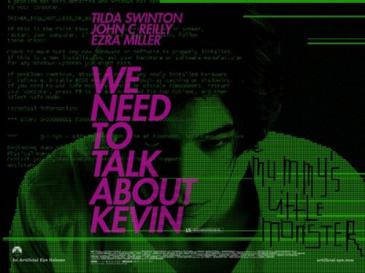
We Need to Talk about Kevin (Lynne Ramsay, 2011)

The first third of Lynne Ramsay’s “We Need to Talk about Kevin” grabs you by the neck and does not let go. Through the use of disjointed storytelling and unique, ambiguous visuals, the film’s opening perfectly achieves a sense of unfathomable disorientation, luring you into its distressing story. The film follows Eva—a fantastic Tilda Swinton—after her life falls apart. Through a series of flashbacks we learn that her teenage son Kevin has murdered his father, sister, and nine high school students. Eva is thus forced to live in a society that hates and blames her, haunted by her own maternal demons.

Like the book it is based on, the film is bound to leave you thinking about the origin of violence and the nature of mother-son relationships. Unfortunately, its tone falters in the middle, as it eschews its disjointed storytelling, adopting a more traditional structure intertwining Eva’s life before and after the traumatic event in a linear fashion. At times it also feels like the film overdoes its successes. Artistically, it overuses some of its visual motifs, making a nuanced film appear too obvious. In its narrative, the middle of the film, probably emulating the novel’s epistolary structure, often feels like a series of vignettes about Kevin’s evil actions growing up, failing to uphold the first third’s cohesiveness. The film’s ending, however, recaptures the opening’s tension and features one of the most terrifying and beautiful conclusions of any film this year.

Recommended (B+)

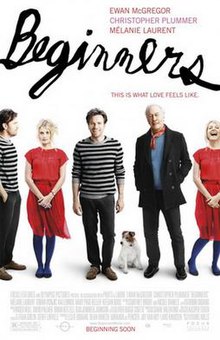
Beginners (Mike Mills, 2011)

After the death of his father, Oliver (Ewan McGregor) reflects about his own life and mortality, while beginning a new romantic relationship. With the exception of some interesting artistic and storytelling decisions, most of the main love story of Mike Mill’s “Beginners” is monotonous and, within its “hipster” novelty, predictable. The real heart of this film lies in its flashbacks, which recount the relationship between Oliver and his father Hal (Christopher Plummer), who comes out as a homosexual in his old age. Plummer deserves every accolade he has accrued for this performance. He transitions smoothly between comedy and drama, delivering one of the most heartfelt and pure performances of the year. Mills, who had already shown great promise as a screenwriter in 2004 with the underrated “Thumbsucker,” embellishes “Beginners” with some very beautiful scenes between Oliver and Hal: truthful conversations about love and life.

I am unable to fully jump on the “Beginners” bandwagon because every time the film returned to Oliver’s brooding romance, I immediately lost interest. The movie eventually fails to be as fantastic as it could have been due to the uneven quality and originality of its two storylines.

Recommended (B)

Monday, January 2, 2012

In a Better World (Susanne Bier, 2010)

The 2011 winner of the Academy Award for Best Foreign Film is as bleak as it gets. Susanne Bier’s “In a Better World” is perfectly designed, technically, artistically, and dramatically, to keep you at the edge of your seat. The film tells the story of two Danish families, whose lives become interconnected due to the friendship of their children. Christian—the young William Jøhnk Nielsen in a virtuoso performance—is a troubled preteen who moves to Denmark with his absent father after the death of his mother. Elias is a shy young boy who is constantly picked on at school. His parents are the caring Marianne, and Anton, a Swedish doctor who spends most of the year working in a refugee camp in North Africa.

Taking us from the gruesome violence of a Sudanese refugee camp to the vicious nature of first world bullying and class relations, “In a Better World” is a powerful quasi-clinical study of the causes, consequences, and universality of human aggression. However, despite its flawless editing, the second half of the film drags a bit and feels thematically repetitive. The screenplay also fails to truly interlace its various storylines, which work fantastically on their own, but feel disjointed together. Despite its flaws, “In a Better World” is a fine example of the great quality of current Danish cinema.

Recommended (B+)

Saturday, December 31, 2011

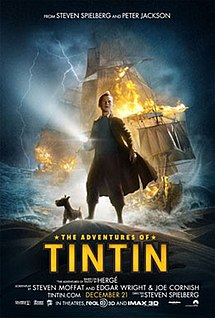
The Adventures of Tintin (Spielberg, 2011)

Steven Spielberg’s adaptation of the celebrated Belgian comic “The Adventures of Tintin” is not only a technical marvel, but also one of the most entertaining movies of the past year. The film recounts the story of Tintin, a young reporter, who with the help of his dog Snowy and alcoholic friend Captain Haddock, uncovers the long-lost secret of a sunken ship. As a fan of Hergé’s original work, I cannot picture a better cinematic adaptation of the comic book. Spielberg, a true master of adventure films, has crafted two hours of endless fun with intricate CGI action sequences. The film’s animation is spectacular, to the extent that the “perfection” of the motion-capture characters is often uncanny.

“The Adventures of Tintin” adapts three of Hergé’s comics, and manages to craft a coherent, intricate screenplay that keeps you entertained throughout the film. The film’s dramatic structure, however, is slightly flawed. Due to the film’s continuous adventure sequences, its climax falls flat, as it fails to match the excitement of the buildup. In a way, it feels like Spielberg—and producer Peter Jackson—thought of the film as a preamble for further Tintin adventures, so the film’s climax and ending feel inconclusive.

Recommended (B+)

Thursday, December 29, 2011

Weekend (Andrew Haigh, 2011)

Russell and Glen meet at a club and subsequently sleep with each other. The following morning, what began as a one-night-stand, becomes a short-lived relationship, cut short by Glen’s impending departure to the United States. In the spirit of films like “Before Sunrise,” the most remarkable element of Andrew Haigh’s “Weekend” is its honesty. At its core, the film is a 90-minute conversation between the protagonists, in which we come to know them inside out, through discussions of their past relationships, gay politics, and family life.

In a mere hour and a half, Haigh captures the essence of modern relationships with incredibly realistic dialogue and characters. The film’s protagonists talk like real people, and are not stereotypical impeccably dressed stereotypical gay men, but human beings with dead-end jobs and stubble. The film does not shy away from the awkwardness of sex and portrays the characters’ insecurities remarkably. The film’s “slice of life” structure, however, is also its biggest defect, as it never truly evolves from its original setup. While the film is well written and acted, it is too close to home and, in a way, formulaic in the way it breaks the unwritten rules of romantic movies.

Recommended (B+)

Friday, December 16, 2011

Extremely Loud & Incredibly Close (Jonathan Safran Foer, 2005)

"Extremely Loud and Incredibly Close" follows Oskar Schell, an extremely creative boy who lost his father on 9/11. He sets out to find the lock for a mysterious key his father left behind, traversing New York’s myriad neighborhoods. The novel has moments of greatness, particularly Oskar’s grandfather’s descriptions of the bombings of Dresden, and the child’s initial encounters in his journey. Foer also allows the reader to enter the protagonist's imaginative mind through the book itself, which intertwines text and images beautifully, and even plays with the typeset. The last third of the novel, however, feels rushed, as it attempts to resolve several complex storylines in a limited number of pages. By the end of the book, Foer has built a complex mythology around Oskar's unique vision of the world, but fails to fully develop it, thus providing a lackluster climax.

The novel is often heartbreaking and reminds us that we would all like to be able to respond to tragedy like children: to imagine that skyscrapers can grow roots to avoid ever falling down, and that our loved ones left us an impossible mission so we can stay close to them even after they depart.

Recommended (B+)