Friday, February 17, 2012

Remembering the Aughts (5 under-appreciated films)

Hey guys,

I know it's been a while since my last review. Unfortunately, school and some personal issues have taken their toil on me. I do have a few book and movie reviews almost ready, which I will be uploading on Sunday. Until then, I decided to remember some of the best films of the first decade I lived in from start to finish. I have, however, decided to stir some things up and, instead of doing the classic "Best of" list, feature 5 of my favorite under-appreciated films. Hopefully they'll make you as happy as they make me:

5. Me and you and everyone we know (Miranda July, 2005)
Worldwide Gross: $8,012,838
This is an extremely weird film, and I do not expect everyone to like it. If you get over its queerness, however, you will be able to appreciate Miranda July’s unique voice in a world populated by formulaic “indie” quirky comedies.
http://www.youtube.com/watch?v=2TTGhyp-mhE

4. XXY (Lucia Puenzo, 2007)
Worldwide Gross: $2,728,869
In “XXY,” Lucia Puenzo has crafted one of the most honest depictions of gender identity in celluloid. Painful, brutal, and perversely funny at times, “XXY” is one of the best Latin American films of the past decade.
www.youtube.com/watch?v=cWcyZDMm1rE

3. Duck Season (Fernando Eimbcke, 2004)
Worldwide Gross: $155,410
Nothing happens in this movie: It is, quite literally, a study of boredom. “Duck Season” is, however, also incredibly heartfelt, and one the ultimate portrait of the Millennium Generation.
http://www.youtube.com/watch?v=cWcyZDMm1rE

2. Margot at the Wedding (Noah Baumbach, 2007)
Worldwide Gross: $2,897,757
Most people deemed Noah Baumbach’s follow-up to “The Squid and the Whale” a disappointment. For me, “Margot at the Wedding,” a film plagued by unlikable characters and myriad uncomfortable moments, is incredibly risky, yet equally enthralling.
http://www.youtube.com/watch?v=_NQobRrZhvo

1. Shortbus (John Cameron Mitchell, 2006)
Worldwide Gross: $5,516,192
John Cameron Mitchell's sophomore success grows on you. It is provocative, sexually-explicit, and despite its elements of magical realism, one of the most truthful tales of life, romance, and sex that have ever been showcased on celluloid.
www.youtube.com/watch?v=H8A1dwEhSMY

Runner-ups in chronological order: Hedwig and the Angry Inch (Mitchell, 2001), Last Life in the Universe (Ratanaruang, 2003), Shopgirl (Tucker, 2005), Silent Light (Reygadas, 2007), Son of Rambow (Jennings, 2007), Synecdoche, New York (Kaufman, 2008), The Class (Cantet, 2008).

Thursday, January 26, 2012

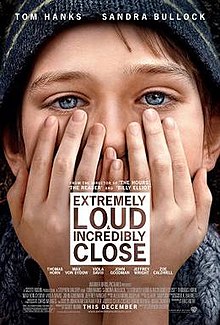
Extremely Loud & Incredibly Close (Stephen Daldry, 2011)

“Extremely Loud and Incredibly Close” is a deeply flawed film: over-sentimental, with a haphazardly changing tone, and an annoying voiceover. Yet, I cannot help but consider it one of the best films of the year. Led by the extraordinary young actor Thomas Horn, the film captures the misery of the 9/11 tragedy and crafts an incredibly sad, yet equally heartfelt and hopeful work. Based on Jonathan Safron Foer’s novel [previously reviewed], Stephen Daldry’s film tells the story of Oskar Schell, who sets out on a mission throughout New York to find the lock for a mysterious key his dead father—a victim of the September 11 attacks—left behind.

The film’s imperfections only further its impact. Like Oskar’s youthful grief, the film is often reckless, yet emotionally powerful. Daldry’s claustrophobic close-ups and visceral array of unusual angles perfectly frame the film, and bolster superb supporting performances by Sandra Bullock, Max Von Sydow, and Viola Davis. I do not expect everyone to like this film, and can definitely understand why people call it emotionally manipulative. However, I believe that films do not need to be perfect, but like every artform, should seek to transcend the cognitive and resonate emotionally in the audience. “Extremely Loud and Incredibly Close” made me cry.

Highly Recommended (A-)

Sunday, January 15, 2012

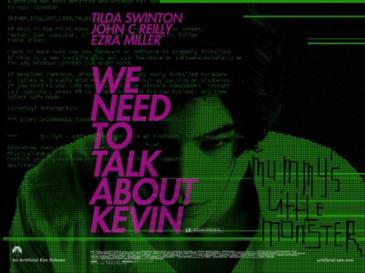
We Need to Talk about Kevin (Lynne Ramsay, 2011)

The first third of Lynne Ramsay’s “We Need to Talk about Kevin” grabs you by the neck and does not let go. Through the use of disjointed storytelling and unique, ambiguous visuals, the film’s opening perfectly achieves a sense of unfathomable disorientation, luring you into its distressing story. The film follows Eva—a fantastic Tilda Swinton—after her life falls apart. Through a series of flashbacks we learn that her teenage son Kevin has murdered his father, sister, and nine high school students. Eva is thus forced to live in a society that hates and blames her, haunted by her own maternal demons.

Like the book it is based on, the film is bound to leave you thinking about the origin of violence and the nature of mother-son relationships. Unfortunately, its tone falters in the middle, as it eschews its disjointed storytelling, adopting a more traditional structure intertwining Eva’s life before and after the traumatic event in a linear fashion. At times it also feels like the film overdoes its successes. Artistically, it overuses some of its visual motifs, making a nuanced film appear too obvious. In its narrative, the middle of the film, probably emulating the novel’s epistolary structure, often feels like a series of vignettes about Kevin’s evil actions growing up, failing to uphold the first third’s cohesiveness. The film’s ending, however, recaptures the opening’s tension and features one of the most terrifying and beautiful conclusions of any film this year.

Recommended (B+)

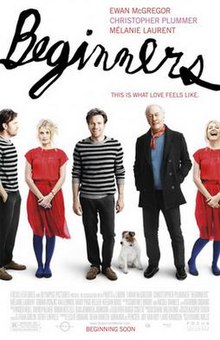
Beginners (Mike Mills, 2011)

After the death of his father, Oliver (Ewan McGregor) reflects about his own life and mortality, while beginning a new romantic relationship. With the exception of some interesting artistic and storytelling decisions, most of the main love story of Mike Mill’s “Beginners” is monotonous and, within its “hipster” novelty, predictable. The real heart of this film lies in its flashbacks, which recount the relationship between Oliver and his father Hal (Christopher Plummer), who comes out as a homosexual in his old age. Plummer deserves every accolade he has accrued for this performance. He transitions smoothly between comedy and drama, delivering one of the most heartfelt and pure performances of the year. Mills, who had already shown great promise as a screenwriter in 2004 with the underrated “Thumbsucker,” embellishes “Beginners” with some very beautiful scenes between Oliver and Hal: truthful conversations about love and life.

I am unable to fully jump on the “Beginners” bandwagon because every time the film returned to Oliver’s brooding romance, I immediately lost interest. The movie eventually fails to be as fantastic as it could have been due to the uneven quality and originality of its two storylines.

Recommended (B)

Saturday, January 14, 2012

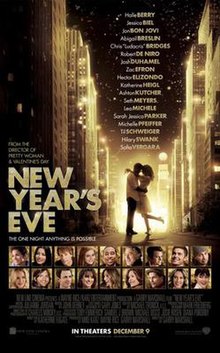
New Year's Eve (Garry Marshall, 2011)

In the style of his previous film—which I thankfully did not see—Garry Marshall’s “New Year’s Eve,” depicts a series of stories about relationships right on the last day of 2011. With the help of a large ensemble cast of familiar faces, from Zac Efron to Robert DeNiro, Marshall delivers a tediously long game of Spot-the-Star. While the movie attempts to portray classic holiday love stories tied with the season’s sense of possibility, if my New Year were ever as boring and mediocre as Marshall’s film, I would immediately cease all further celebrations.

Some of the stories are slightly enjoyable. For example that of Ingrid (Michelle Pfeiffer), a shy secretary who quits her job and hires delivery boy Paul (Zac Efron) to fulfill a series of fantastical New Year’s resolutions before midnight. None of them, however, is decent enough to lift this clunky, dull, poorly scripted holiday bomb. “New Year’s Eve” upholds the [new?] Hollywood tendency that if you get enough A-listers in one room, you can forego the screenplay. Filmmakers need to remember that what made “Love Actually” such a fantastic holiday movie was its pitch-perfect screenplay and overall manufacture, and not its vignette structure.

Not Recommended (D)

The Help (Tate Taylor, 2011)

Tate Taylor’s “The Help” is often condescending and emotionally manipulative. However, despite its use of cinematic gimmicks to control the audience’s tears and laughter, it is not a bad movie. The film narrates the lives of a series of black maids in Jackson, Mississippi and race relations in the South in the early 1960s. When Skeeter, a progressive white woman, returns to Jackson after college, she sets out to write a book about the lives and tribulations of these maids. The book and their stories become entrenched in the Civil Rights movement.

The movie delivers two hours of enjoyable superficial pensiveness about race relations, effectively doing exactly what is expected of it, though nothing else. You will not regret watching “The Help,” but you will have forgotten most of it after a week. The ensemble cast, however, rises beyond the film’s limitations and features some of the best performances of the year, particularly from Viola Davis and the up-and-coming Jessica Chastain. Despite the screenplay’s one-dimensional, stereotypical characterizations—for example, the sassy, witty maid played by the charismatic Octavia Spencer—the performances are quite nuanced and, unlike the film’s emotional manipulation, truthful.

Ambivalent (B-)

Monday, January 2, 2012

In a Better World (Susanne Bier, 2010)

The 2011 winner of the Academy Award for Best Foreign Film is as bleak as it gets. Susanne Bier’s “In a Better World” is perfectly designed, technically, artistically, and dramatically, to keep you at the edge of your seat. The film tells the story of two Danish families, whose lives become interconnected due to the friendship of their children. Christian—the young William Jøhnk Nielsen in a virtuoso performance—is a troubled preteen who moves to Denmark with his absent father after the death of his mother. Elias is a shy young boy who is constantly picked on at school. His parents are the caring Marianne, and Anton, a Swedish doctor who spends most of the year working in a refugee camp in North Africa.

Taking us from the gruesome violence of a Sudanese refugee camp to the vicious nature of first world bullying and class relations, “In a Better World” is a powerful quasi-clinical study of the causes, consequences, and universality of human aggression. However, despite its flawless editing, the second half of the film drags a bit and feels thematically repetitive. The screenplay also fails to truly interlace its various storylines, which work fantastically on their own, but feel disjointed together. Despite its flaws, “In a Better World” is a fine example of the great quality of current Danish cinema.

Recommended (B+)

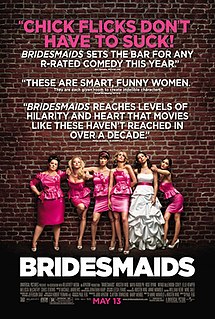
Bridesmaids (Paul Feig, 2011)

Paul Feig’s “Bridesmaids” is probably the best movie to come out of Judd Apatow’s comedy machine. It tells the story of Annie, a woman in her mid-thirties who loses all of her savings when her pastry shop goes bankrupt. After her best friend Lillian gets engaged, Annie starts to compete against one of the bridesmaids—the rich and beautiful Helen—for Lillian’s affection. The screenplay offers plenty of highly comedic moments, particularly in its first half, as it gives us a humorous look at the life of an unsuccessful woman in her mid-thirties. These, however, often turn into tasteless slapstick, so expect your share of toilet humor. The last third of the film, while devoid of crude jokes, is extremely formulaic and presents an obvious and predicable moral ending.

The movie’s biggest asset is its ensemble cast, particularly Kirsten Wigg and Melissa McCarthy’s heartfelt and hilarious performances. The supporting characters, however, are never fully developed. Contrary to what the movie’s publicity may tell you, the viewer barely gets to meet the outlandish bridal party, who would have made the film much better. All in all, “Bridesmaids” is a fine comedy, which, like every movie with the Apatow stamp, eventually falters by eroding its smart jokes with tasteless humor.

Ambivalent (B-)

Saturday, December 31, 2011

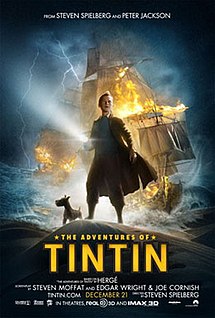
The Adventures of Tintin (Spielberg, 2011)

Steven Spielberg’s adaptation of the celebrated Belgian comic “The Adventures of Tintin” is not only a technical marvel, but also one of the most entertaining movies of the past year. The film recounts the story of Tintin, a young reporter, who with the help of his dog Snowy and alcoholic friend Captain Haddock, uncovers the long-lost secret of a sunken ship. As a fan of Hergé’s original work, I cannot picture a better cinematic adaptation of the comic book. Spielberg, a true master of adventure films, has crafted two hours of endless fun with intricate CGI action sequences. The film’s animation is spectacular, to the extent that the “perfection” of the motion-capture characters is often uncanny.

“The Adventures of Tintin” adapts three of Hergé’s comics, and manages to craft a coherent, intricate screenplay that keeps you entertained throughout the film. The film’s dramatic structure, however, is slightly flawed. Due to the film’s continuous adventure sequences, its climax falls flat, as it fails to match the excitement of the buildup. In a way, it feels like Spielberg—and producer Peter Jackson—thought of the film as a preamble for further Tintin adventures, so the film’s climax and ending feel inconclusive.

Recommended (B+)

Everyman (Philip Roth, 2006)

“Everyman” opens with the funeral of an unnamed protagonist: a restrained event populated mostly by silence, which the reader experiences as an outsider. Philip Roth uses this starting point to barrage the reader with illnesses, failed marriages, and death, and tell the life of the deceased, unnamed man, focusing solely on his darkest moments. The novel draws inspiration from the 15th century morality play “The Summoning of Everyman,” in which God tallies a man’s good and evil deeds to determine his salvation. Roth similarly seeks to measure the worth of man, in accordance to his sins and moral failures. Despite the bleak stage Roth gives him, the reader is able to identify with the protagonist. This is “Everyman’s” greatest success: the universality of the human weaknesses it describes. We are the everyman.

Like most of Roth’s works, “Everyman” is constructed flawlessly, carefully releasing information about the protagonist’s life until the funeral’s silences acquire deep meaning. Roth’s prose flows very smoothly, and allows you to know the main character, but never to enter his mind. Like God’s judgment in the original passion play, Roth welcomes the reader to measure the value of the everyman’s life with no room for subjectivity. “Everyman” is not a perfect book, but it is definitely another triumph by one of the essential writers of our time.

Highly Recommended (A-)

Thursday, December 29, 2011

Weekend (Andrew Haigh, 2011)

Russell and Glen meet at a club and subsequently sleep with each other. The following morning, what began as a one-night-stand, becomes a short-lived relationship, cut short by Glen’s impending departure to the United States. In the spirit of films like “Before Sunrise,” the most remarkable element of Andrew Haigh’s “Weekend” is its honesty. At its core, the film is a 90-minute conversation between the protagonists, in which we come to know them inside out, through discussions of their past relationships, gay politics, and family life.

In a mere hour and a half, Haigh captures the essence of modern relationships with incredibly realistic dialogue and characters. The film’s protagonists talk like real people, and are not stereotypical impeccably dressed stereotypical gay men, but human beings with dead-end jobs and stubble. The film does not shy away from the awkwardness of sex and portrays the characters’ insecurities remarkably. The film’s “slice of life” structure, however, is also its biggest defect, as it never truly evolves from its original setup. While the film is well written and acted, it is too close to home and, in a way, formulaic in the way it breaks the unwritten rules of romantic movies.

Recommended (B+)

Monday, December 26, 2011

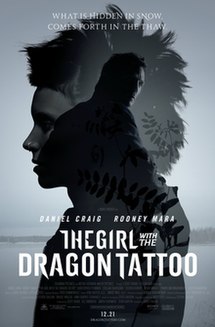
The Girl with the Dragon Tattoo (David Fincher, 2011)

David Fincher usually finds the exact balance between cutting-edge visuals and compelling, exquisitely told stories. His latest opus, however, features Fincher’s intricate visual world, but without the necessary narrative backdrop. Based on Stieg Larsson’s bestseller—which I have no intention of reading—“The Girl with the Dragon Tattoo” follows journalist Henrik Vanger as he tries to uncover a murder from decades prior. He consequently hires Lisbeth Salander, an ill-adjusted computer genius, as his assistant.

The true heart of the film is Rooney Mara as Salander, who brings to the table a perfect combination of vulnerability and power. However, as soon as she leaves the screen, the film continues to drag, due to Craig’s cardboard performance, and the film’s overall lack of engagement with the audience. Fincher’s latest work takes too long to take off—an hour passes before Vanger even meets Salander—and never really pays off. While “The Girl with the Dragon Tattoo” is visually and aurally striking (especially Trent Reznor and Atticus Ross’ haunting score), the narrative structure feels like clunky patchwork, as the film attempts to include myriad unnecessary elements into the plot—such as a ridiculous love story between the protagonists—probably in an attempt to please the book’s fans. Besides Mara and the technical elements of the film, I was unable to find many differences between “The Girl with the Dragon Tattoo” and a decent episode of “CSI.”

Ambivalent (B-)

Tuesday, December 20, 2011

The Artist (Michel Hazanavicius, 2011)

A profound feeling of nostalgia lies at the core of Michael Hazanavicius’ celebrated film “The Artist.” This sense of longing, however, differs greatly from the glorified visions of the past of “Stand by me” or “Super 8.” The film, silent and shot in black-and-white, follows George Valentin, a famous silent film actor who goes broke and unemployed with the arrival of “talkies.” Few people watching “The Artist” will be able to reminisce about the days of silent film. Rather, its nostalgia signifies our fear of a future in which we are expendable, and the consequent clinging to the familiarity of the past. Even I, a member of the so-called Generation Z, can attest to that: we shun current children’s television and yearn for “the Golden Age” of Nickelodeon, and list things that made our “nineties childhood” great in myriad Facebook groups. We are terrified of the day we graduate from college.

The film thus becomes a visual manifestation of the “Museum Century,” paying homage to the great art of silent film. “The Artist,” however, never becomes a post-modern pastiche of anachronistic cinematic techniques: It is at the same time, a well-told, delectable celebration of the past, and an examination of innate human fears. From a technical standpoint, the film is gorgeous. The protagonists Jean Dujardin and Bérénice Bejo exude charisma, even when the film starts to drag in the middle. The true scene-stealer, however, is Uggie as the protagonist’s dog.

Highly Recommended (A-)

Saturday, December 17, 2011

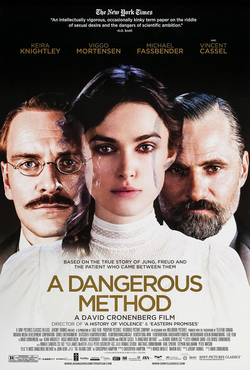
A Dangerous Method (David Cronenberg, 2011)

David Cronenberg’s “A Dangerous Method” introduces us to renowned Swiss psychiatrist Carl Jung and his turbulent relationships with Sigmund Freud and Sabina Spielrein, a beautiful, young woman suffering from hysteria who becomes his patient and mistress. The film, however, fails to move beyond this basic framework and, after a fantastic opening featuring Sabina’s treatment through psychoanalysis, ends up being a series of vignettes of the protagonists’ intersecting lives. Unlike Cronenberg’s earlier films, “A Dangerous Method” fails to sustain a consistent mood, and thus starts to drag near the middle.

The performances partly redeem the sinking film. As Sabina, Keira Knightley delivers a haunting performance as a mentally-disturbed, manipulative, and determined woman. Michael Fassbender as Jung and Viggo Mortensen as Freud have excellent chemistry, but the film’s lackluster screenplay fails to provide an appropriate backdrop for their flair.

Ambivalent (C+)

Friday, December 16, 2011

Extremely Loud & Incredibly Close (Jonathan Safran Foer, 2005)

"Extremely Loud and Incredibly Close" follows Oskar Schell, an extremely creative boy who lost his father on 9/11. He sets out to find the lock for a mysterious key his father left behind, traversing New York’s myriad neighborhoods. The novel has moments of greatness, particularly Oskar’s grandfather’s descriptions of the bombings of Dresden, and the child’s initial encounters in his journey. Foer also allows the reader to enter the protagonist's imaginative mind through the book itself, which intertwines text and images beautifully, and even plays with the typeset. The last third of the novel, however, feels rushed, as it attempts to resolve several complex storylines in a limited number of pages. By the end of the book, Foer has built a complex mythology around Oskar's unique vision of the world, but fails to fully develop it, thus providing a lackluster climax.

The novel is often heartbreaking and reminds us that we would all like to be able to respond to tragedy like children: to imagine that skyscrapers can grow roots to avoid ever falling down, and that our loved ones left us an impossible mission so we can stay close to them even after they depart.

Recommended (B+)

About me (it had to be done)

I have tried doing the blog thing a bunch of times, and have failed every single one of them. I blame my commitment issues. That being said, like any good masochist, I am going to try once more. In the past few months, I have realized that, in many ways, the books I read, and the films I watch, are crucial aspects of my life. So, in 2012, I shall write (roughly) between 150 and 200 words about every book and movie I experience.

My name is Bernardo Sarmiento and I am an English major at Columbia University. I was born in Mexico City and currently live in New York. I am an aspiring academic, author, and screenwriter, and enjoy reading books and watching films more than most people would consider healthy. My favorite filmmaker is Ingmar Bergman and my favorite author is Philip Roth. But enough of me, I will now let the words and images speak for themselves...